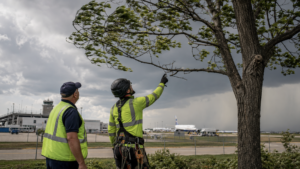
Airports are built around precision. Runways must remain clear, access roads must stay open, lighting and communication systems must continue working, and emergency crews must be able to move without delay. Severe weather can disrupt every part of that system in a matter of minutes. High winds, saturated soil, lightning, hail, and heavy rain can turn a mature tree from an attractive part of the property into a serious operational hazard.
Tree care at an airport is therefore more than routine landscaping. It is a form of risk management. A qualified arborist can identify weak trunks, damaged roots, unstable limbs, overgrown canopies, and trees that may interfere with visibility, equipment, roads, fences, or protected airspace. That work is most valuable before a storm reaches the airport, while there is still time to correct problems in a controlled manner.
An airport is a complicated operating environment that combines aircraft movement, passenger services, emergency response, maintenance, security, utilities, and ground transportation. Trees and vegetation may appear to occupy only the edges of that environment, yet their condition can affect several airport systems at once. A proactive inspection can reduce preventable damage, support faster recovery, and help airport leaders protect passengers, employees, aircraft, and surrounding communities.
Storm Preparation Begins at Ground Level
Storm preparation often focuses on forecasts, flight schedules, drainage, generators, staffing, and emergency communications. Those measures are essential, but the condition of the airport grounds deserves the same attention. A tree with a weakened root system may remain standing through ordinary weather and fail when the soil becomes saturated. A large limb with an old crack may look stable until repeated wind gusts place additional pressure on the damaged union.
The Federal Aviation Administration’s airport safety resources emphasize organized safety practices, airport certification, runway safety, wildlife management, and safety management systems. Vegetation belongs within that wider safety picture because it can create hazards that cross departmental lines. A fallen tree near an access road may delay maintenance crews. Broken limbs near a parking area may damage vehicles or injure pedestrians. Debris near an operational surface may require immediate inspection and removal before normal activity resumes.
A professional arborist examines more than the visible shape of a tree. The assessment considers trunk condition, root stability, canopy balance, branch attachment, decay, previous storm damage, soil changes, nearby construction, and the consequences of failure. At an airport, the consequences matter as much as the probability. A declining tree beside an unused field presents a different level of concern than the same tree beside a terminal road, fuel facility, perimeter fence, navigation installation, or emergency route.
Trees Can Become Airfield Hazards
Airports must maintain clear operating areas and protect the airspace used for arriving and departing aircraft. Trees that grow into restricted areas can become obstructions, while trees located outside those areas can still produce branches, leaves, and debris that move onto pavement during severe weather.
The FAA’s guidance on vegetation in the airport environment addresses the management of trees that penetrate or may eventually penetrate protected navigable surfaces. This guidance reflects a central airport-management principle: vegetation should be evaluated according to its location, mature height, growth pattern, and effect on safe operations. Removing a hazardous tree before a storm is usually safer, less disruptive, and more economical than handling an uncontrolled failure after the storm.
Tree debris can also contribute to foreign object debris concerns. The FAA defines airport foreign object debris broadly as material in an inappropriate location that can injure personnel or damage aircraft. The agency’s Foreign Object Debris Program explains why inspection, prevention, and prompt removal are important parts of airport safety. Limbs, bark, cones, stakes, damaged guards, and pieces of landscaping material can all be scattered by strong winds. Preventive pruning and careful site maintenance reduce the amount of material available to become airborne.
An Arborist Can Find Failure Points Before the Wind Does
Healthy-looking trees can contain defects that are easy to miss from the ground. Internal decay may be hidden behind intact bark. A narrow branch union may contain included bark that weakens the connection between two large stems. Roots may have been cut during utility work or compacted by vehicles. A tree may also lean because of recent soil movement rather than natural growth.
A qualified arborist reads these details as part of a complete risk assessment. The goal is not to remove every large tree near an airport. The goal is to identify conditions that create an unacceptable likelihood of failure or an unacceptable consequence if failure occurs. Appropriate work may include selective pruning, removal of deadwood, reduction of an overextended limb, cabling or bracing in suitable cases, soil improvement, monitoring, or complete removal.
Airports looking for a qualified local provider may begin with a reputable directory or a targeted search for Arborists Near Me, then verify credentials, insurance, equipment, airport experience, and familiarity with controlled-access work. Airport tree care requires disciplined coordination. Crews may need escorts, identification, radio procedures, equipment checks, traffic control, work-zone restrictions, and precise schedules that avoid conflicts with aircraft and passenger activity.
Severe Weather Can Disrupt More Than Flights
Airport storm coverage often centers on delays and cancellations, but the work on the ground is equally important. The FAA’s Daily Air Traffic Report routinely identifies thunderstorms, high winds, low clouds, and other weather conditions that may affect major airports. These reports illustrate how quickly weather can influence the national aviation system. A local tree failure can add another operational problem at the exact moment airport teams are already managing weather-related pressure.
A blocked service road can slow inspections. A tree across a public entrance can interrupt passenger access. Fallen limbs can damage fencing, signs, lighting, parked vehicles, utility lines, or communication equipment. Debris may clog drains and worsen localized flooding. Even when the runway remains open, damage elsewhere on the property can affect staffing, security, customer movement, deliveries, and emergency response.
The National Weather Service aviation program notes that thunderstorms can produce lightning, heavy rain, hail, and gusty or erratic winds. Those conditions place trees under several forms of stress at once. Wind loads the canopy, saturated soil weakens root anchorage, and lightning can damage a tree immediately or create injuries that lead to decline later. An arborist helps airport managers understand which trees are most likely to fail under those combined conditions.
Vegetation Management Also Supports Wildlife Control
Trees provide shade, visual appeal, erosion control, and environmental benefits, but the wrong species in the wrong location can attract birds or other wildlife. Fruit, seeds, dense cover, nesting sites, and standing water near vegetation may increase wildlife activity in areas where it creates an aviation concern.
The FAA’s wildlife management guidance explains that airport wildlife management may involve habitat modification and other methods designed to reduce hazardous animal activity. Arborists can contribute useful knowledge about tree species, seasonal fruiting, canopy density, nesting potential, and vegetation changes that may influence wildlife patterns. Tree decisions should therefore be coordinated with the airport’s wildlife-hazard strategy rather than treated as isolated landscaping choices.
This coordinated approach prevents one department from solving a problem while unintentionally creating another. Planting a dense row of attractive trees may improve the appearance of a public roadway, yet the same planting could obstruct views, interfere with security observation, attract flocking birds, or create a future maintenance burden. An arborist working alongside airport operations, environmental staff, engineers, and wildlife specialists can help select practical solutions that account for mature size and long-term behavior.
Clear Access Matters During Emergency Response
Storm recovery depends on movement. Airport police, firefighters, maintenance teams, utility crews, contractors, and medical personnel need dependable routes across the property. Trees near emergency gates, fire roads, service drives, and perimeter access points deserve special attention because a single failure can isolate an area or force responders to take a longer route.
Pre-storm arborist work can prioritize those locations according to consequence. Dead limbs above a little-used landscaped area may be scheduled for routine maintenance. A compromised tree beside an emergency entrance may require immediate action. This type of prioritization helps airports direct limited time and resources toward the hazards most likely to affect life safety and continuity of operations.
The same principle applies to public areas. Passengers may gather near terminal entrances, shuttle stops, rental-car facilities, parking structures, and pickup lanes. Trees around these locations should be evaluated for hanging branches, weak attachments, root damage, poor clearance, and conflicts with signs or lighting. Preventive care protects people while preserving healthy trees that contribute to a more welcoming airport environment.
A Written Tree Plan Strengthens Airport Resilience
A one-time inspection can identify urgent problems, but a documented tree-management plan provides greater long-term value. The plan can map significant trees, record condition ratings, note maintenance history, identify high-consequence targets, establish inspection intervals, and define the steps to follow before and after severe weather.
That information supports continuity when staff members change. It also gives airport leadership a defensible record of inspections, recommendations, completed work, and deferred work. Documentation does not eliminate risk, but it improves decision-making and makes it easier to identify patterns. Repeated limb failures, declining groups of trees, drainage changes, or construction-related root damage become clearer when observations are recorded consistently.
The Airports Council International discussion of resilient airport design emphasizes the need to consider infrastructure, operations, environmental conditions, and business continuity together. Tree management fits naturally within that approach. A resilient airport does not wait for visible damage before examining a known exposure. It identifies vulnerable systems, reduces avoidable hazards, and prepares recovery resources in advance.
The Best Inspection Happens Before the Forecast Becomes Urgent
Arborist work is easier to schedule before a storm is only hours away. Crews need time to inspect the property, prepare recommendations, coordinate access, secure equipment, complete pruning or removal, and dispose of debris. Last-minute work also creates its own risks when wind, lightning, or heavy rain is already approaching.
A practical airport program includes routine inspections during calmer periods and an additional review before the region’s primary severe-weather season. Airports in hurricane-prone areas may focus on wind resistance, drainage, saturated soils, and emergency access. Airports in regions with ice storms may place greater emphasis on included bark, end-heavy limbs, brittle species, and branches over power lines or roadways. Tornado, thunderstorm, wildfire, and heavy-snow regions each create different priorities.
Weather information remains central to this process. NOAA’s overview of aviation weather describes the operational importance of wind, visibility, precipitation, thunderstorms, and other atmospheric conditions. An arborist adds site-specific tree knowledge to that broader weather awareness, helping airport managers connect the forecast with conditions already present on the property.
Conclusion
Every airport depends on preparation, coordination, and clear operating space. Trees become part of that responsibility when their location or condition can affect aircraft areas, roads, fences, utilities, drainage, emergency access, wildlife activity, employees, or passengers. A storm does not create every tree defect. It exposes defects that were already present and applies enough force to turn them into failures.
A professional arborist gives airport leadership the opportunity to act before that happens. Through inspections, risk prioritization, preventive pruning, removal, species guidance, and written planning, arborists help reduce avoidable damage and support a faster return to normal operations. Their work protects more than the landscape. It supports the safety, resilience, and reliability of the entire airport.
The strongest time to inspect a vulnerable tree is not after it falls across a road or damages critical equipment. It is before the next storm reaches the airfield, while the airport still has control over the schedule, the work zone, and the outcome.