Airports operate through an enormous network of systems that most travelers never see. Beneath terminals, hangars, runways, maintenance facilities, and aircraft parking areas are pipes, tanks, valves, hoses, fire-suppression equipment, and fueling infrastructure that must perform reliably under pressure. A hidden weakness in any pressurized component can result in a leak, operational disruption, environmental damage, fire hazard, or serious safety emergency.
Hydrotesting is one of the most effective methods used to confirm that pressure-containing equipment can operate safely. The process involves filling a component or system with water or another approved liquid, removing trapped air, and gradually increasing the internal pressure to a specified test level. Technicians then monitor the equipment for pressure loss, leakage, deformation, or other indications of weakness.
While passengers may never witness this work, pressure testing supports the culture of prevention that keeps modern airports functioning safely. It allows maintenance teams to discover vulnerable equipment under controlled conditions instead of waiting for it to fail during fueling, firefighting, maintenance, or daily airport operations. ✈️
Why Pressure Integrity Matters at an Airport
Airports are complex transportation centers where thousands of interconnected activities occur every day. Aircraft are fueled, baggage is moved, passengers are screened, emergency equipment is maintained, and facilities are supplied with water, gas, and other essential services. Each activity depends on infrastructure that must remain dependable despite constant use, vibration, temperature changes, weather exposure, and contact with fuels or industrial chemicals.
A pressurized system can appear perfectly normal from the outside while corrosion, fatigue, defective welds, damaged seals, or thinning walls develop internally. These conditions may remain unnoticed until the system experiences an increase in pressure. If the affected component ruptures, the consequences can extend beyond the immediate equipment.
A failure involving an airport fuel line, for example, may release combustible material near aircraft, service vehicles, electrical equipment, or terminal gates. A damaged fire-protection line could reduce the availability of water during an emergency. A weakened maintenance component could expose technicians to suddenly released pressure or flying debris.
The Federal Aviation Administration publishes guidance concerning the storage, handling, and dispensing of aviation fuel at airports. That guidance reflects the importance of maintaining reliable systems, trained personnel, and disciplined procedures wherever aviation fuel is handled.
How Hydrotesting Identifies Hidden Weaknesses
A professional Hydrotest subjects equipment to a predetermined pressure that is normally higher than its usual operating pressure. The exact test pressure, hold time, preparation procedure, and acceptance criteria depend on the equipment, its materials, its service conditions, and the governing code or manufacturer requirements.
Before testing begins, qualified personnel inspect the system, confirm that the test medium is compatible with the equipment, isolate components that should not be pressurized, and establish a controlled testing area. Air must be removed because compressed air stores substantially more energy than an incompressible liquid. Using a liquid therefore helps reduce the energy released if a component fails during the test.
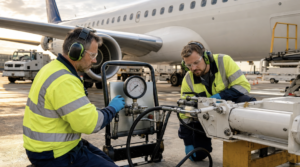
Once the system is filled, pressure is introduced gradually with calibrated equipment. Technicians observe gauges and examine accessible joints, fittings, welds, seals, and component surfaces. A decline in pressure may indicate a leak, although temperature changes and other test conditions must also be considered. Visible distortion, sweating, cracking, or leakage can reveal that the system requires repair or replacement.
The objective is not merely to prove that equipment can hold pressure for a few minutes. Testing creates documented evidence that the system met established acceptance requirements at the time of inspection. Those records can support maintenance planning, regulatory compliance, quality assurance, and future equipment evaluations.
Airport Systems That May Require Pressure Testing
Hydrostatic testing can apply to several types of airport and aviation-support equipment. Fuel-storage tanks, transfer lines, underground hydrant systems, maintenance piping, fire-protection systems, pressure vessels, hoses, and related components may require testing during manufacturing, installation, repair, modification, or scheduled inspection.
Large commercial airports often use underground fuel-distribution systems to move aviation fuel from storage areas to hydrant pits near aircraft gates. This arrangement reduces the number of fuel trucks traveling across busy ramps, but it also places considerable responsibility on the integrity of underground piping, valves, and connections. A leak may be difficult to detect immediately and can create environmental and operational consequences.
Aircraft rescue and firefighting facilities also depend on equipment that must work without hesitation. Water lines, pumps, storage vessels, and selected suppression-system components must remain ready for emergency use. The FAA conducts extensive airport safety research, including evaluations of firefighting materials and systems intended for aviation fuel fires.
Pressure testing may also be performed on equipment used away from the runway. Airport maintenance shops, heating and cooling plants, fueling facilities, and utility operations contain pressurized systems that support the broader aviation environment. A failure in one of these areas can close facilities, delay flights, disrupt tenant operations, or divert airport personnel from other critical responsibilities.
Preventing Failures Before They Reach the Flight Line
The phrase “before takeoff” refers to more than the aircraft’s final moments on the runway. Safe departure begins much earlier, with the infrastructure and ground operations that prepare an aircraft for flight. Fuel must be stored correctly, transferred without contamination, and delivered in the proper quantity. Emergency services must be ready. Maintenance equipment must operate as expected, and the surrounding airport environment must remain controlled.
Hydrotesting supports this process by moving failure discovery into a planned maintenance setting. If a fitting leaks during a controlled test, the affected area can be isolated and repaired. If the same fitting fails unexpectedly during active fueling, personnel may need to stop operations, establish a safety perimeter, contain the spill, protect nearby aircraft, and initiate an emergency response.
The National Transportation Safety Board issues safety alerts intended to help aviation professionals recognize and prevent hazards, including problems associated with aircraft fuel systems and fuel contamination. Its work demonstrates why warning signs, inspection findings, and equipment deficiencies must be addressed before they contribute to an accident.
Prevention is especially important at airports because operations are interconnected. One equipment failure can affect an entire gate area, terminal, taxiway, or fuel-distribution network. Even when no one is injured, the resulting delays, cancellations, cleanup expenses, and public concern can be substantial.
Why Water Is Commonly Used for Pressure Testing
Water is frequently selected because it is readily available, generally economical, and nearly incompressible. When used correctly, it allows technicians to apply pressure without storing the same level of energy that would be present during a pneumatic test using compressed gas.
That distinction is important. If a system filled with compressed gas ruptures, the expanding gas can release energy violently. A liquid-filled system can still present serious hazards, particularly at high pressure, but the potential energy is typically lower. This is one reason hydrostatic methods are often preferred when they are compatible with the equipment and testing requirements.
Water is not automatically suitable for every application. Test planners must consider corrosion, contamination, freezing conditions, drainage, disposal, material compatibility, and the possibility of residual moisture. Equipment intended for fuel, oxygen, chemicals, or specialized aviation service may require a carefully selected test fluid and detailed post-test cleaning or drying procedures.
Testing must follow recognized codes, engineering specifications, manufacturer instructions, and site-specific safety requirements. It should never be treated as a general procedure that can be performed identically on every airport system.
Qualified Personnel and Controlled Procedures Are Essential
Pressure testing is valuable only when it is planned and performed correctly. Technicians must understand the equipment, test boundaries, expected pressure, instrument limitations, and potential failure modes. Gauges and recording devices should be appropriate for the pressure range and maintained according to applicable calibration requirements.
The test area must be secured to keep unnecessary personnel away from pressurized equipment. Connections, plugs, temporary closures, and hoses must be rated for the intended pressure. Test pressure should be raised gradually, and personnel should avoid standing in front of closures or other components that could be ejected during a failure.
The Occupational Safety and Health Administration provides workplace safety information that can help employers develop broader programs for controlling industrial hazards. Airport organizations must combine applicable workplace requirements with aviation regulations, engineering standards, fire codes, environmental rules, and their own safety-management procedures.
The International Civil Aviation Organization describes safety management as a systematic approach to identifying hazards, analyzing information, assessing risks, and improving performance. Hydrotesting fits naturally within that preventive structure because it generates information about equipment condition before a failure occurs.
Testing Records Strengthen Maintenance Decisions
Documentation transforms a completed pressure test into a useful maintenance asset. A professional report may identify the equipment tested, test date, technician, pressure level, hold time, test medium, gauge information, ambient conditions, inspection results, and any corrective action taken.
These records allow airport operators and contractors to compare results over time. Repeated repairs, recurring leakage, or changes in performance may indicate that a system is reaching the end of its service life. Maintenance leaders can then evaluate whether continued repair is practical or whether replacement should be scheduled.
Accurate records also help prevent uncertainty during audits, ownership changes, construction projects, and incident investigations. They establish what was tested, how the work was performed, and whether the equipment satisfied the applicable criteria.
This approach aligns with the broader aviation emphasis on traceability and continuous improvement. Airports Council International provides airport safety education focused on managing risk, strengthening operational resilience, and maintaining high standards across airport operations.
Hydrotesting as Part of a Larger Safety Program
A successful pressure test does not guarantee that equipment will remain safe indefinitely. Corrosion can continue, seals can deteriorate, accidental damage can occur, and operating conditions can change. Hydrotesting must therefore be combined with routine inspection, leak detection, preventive maintenance, corrosion control, employee training, and prompt reporting of unusual conditions.
Visual inspections remain important because they may reveal rust, staining, damaged supports, vibration, loose fittings, or evidence of past leakage. Monitoring systems can provide warnings when pressure, flow, or inventory levels change unexpectedly. Non-destructive examination methods may also be used to evaluate welds, wall thickness, or surface defects without damaging the equipment.
Airport employees play an important role because they work around these systems every day. A fuel odor, unexplained wet area, damaged valve, irregular gauge reading, or unusual pump behavior should be reported immediately. Small observations can provide the earliest indication that a system needs attention.
The aviation industry’s focus on layered safety is reflected in the history and development of the modern airport. Today’s facilities combine transportation, security, emergency response, engineering, environmental management, and public services within a single operating environment. No individual test can manage every risk, but each reliable safety layer reduces the possibility that one defect will develop into a major event.
Protecting People, Aircraft, and Airport Operations
The immediate purpose of hydrotesting is to verify pressure integrity, but its broader value reaches much further. Reliable equipment protects airport employees, airline crews, passengers, contractors, emergency responders, and surrounding communities. It also helps protect aircraft, buildings, groundwater, soil, and other valuable resources.
Fuel leaks and pressure failures can be costly even when they do not cause a fire. Cleanup work may require excavation, environmental investigation, contaminated-material removal, and extended operational restrictions. A disabled fire-suppression system can create unacceptable exposure until repairs are completed. A failed utility line can close a terminal area or interrupt essential services.
Hydrotesting provides an opportunity to locate deficiencies before normal operations place people and property at risk. That preventive value makes it an important component of responsible airport maintenance rather than a simple box on an inspection checklist.
Conclusion
Air travelers rarely see the pressurized infrastructure that supports every departure, yet the reliability of that infrastructure is fundamental to airport safety. Fuel lines, storage equipment, fire-protection systems, maintenance components, and utility networks must withstand demanding conditions without leaking or rupturing.
Hydrotesting helps airport operators, aviation contractors, and maintenance teams identify weaknesses under controlled conditions. When performed by qualified professionals using appropriate procedures and accurate equipment, it can expose defective materials, weakened connections, damaged seals, and other problems before they create an emergency.
Safe flights depend on far more than what happens inside the cockpit. They begin with careful engineering, disciplined inspection, detailed documentation, and a commitment to correcting problems before an aircraft leaves the ground. By confirming that critical systems can safely withstand pressure, hydrotesting strengthens one of aviation’s most important principles: prevent the failure before takeoff.